The Hidden Mistake That Can Ruin Your Homemade Korean Ferments
The most damaging Korean fermentation mistakes are not always dramatic. A batch of kimchi can look perfectly ordinary while a small change in salt concentration, temperature, oxygen exposure, or timing has quietly shifted the microbial ecosystem. That is why Korean fermentation mistakes are better understood as process-control problems than as a collection of mysterious kitchen taboos.
Traditional Korean fermentation is not a single recipe or a single microbial event. Kimchi, doenjang, gochujang, ganjang, and jeotgal use different raw materials, salt levels, vessels, temperatures, and maturation periods. Even within kimchi, the microbial community changes as fermentation proceeds. The useful question is therefore not simply, “Did I follow the recipe?” It is, “Did the conditions still favor the fermentation I intended?”
The hidden mistake is treating fermentation as a timer
A common home-fermentation assumption is that a recipe has one correct number of hours or days. Scientific evidence points to a more complicated picture. Fermentation speed depends on temperature, available carbohydrates, salt concentration, raw-material composition, microbial starting populations, and the stage already reached by the ferment.
Research on kimchi shows that different lactic acid bacteria become prominent at different stages. Temperature can alter bacterial succession and the metabolites produced along the way. This means that “three days” does not describe exactly the same biological process in a warm kitchen as it does in a cool one.
The practical interpretation is important: time is an observation point, not an independent guarantee of fermentation quality. If a batch is unusually warm, unusually cold, heavily salted, lightly salted, or made with substantially different ingredients, the expected timeline can shift.
Salt is more than seasoning
In Korean vegetable fermentation, salt has several jobs at once. It changes water movement in plant tissue, affects texture, influences which microorganisms can compete successfully, and helps shape the rate and character of fermentation. Changing the salt concentration can therefore change the fermentation rather than merely making the finished kimchi taste saltier or less salty.
Comparative research on kimchi fermented under different salinity conditions has found corresponding differences in physicochemical properties, microbial communities, and metabolites. That finding explains why casually substituting a much lower or higher salt level can produce a batch that behaves differently even when every other ingredient appears unchanged.
This is also where an apparently sensible shortcut can fail. Reducing salt because the final product tastes too salty is not equivalent to reducing salt in a controlled formulation. If X is a tested recipe with a known salt concentration, keep the concentration consistent when the goal is repeatability. If the goal is deliberate salt reduction, treat it as a new fermentation process that may require separate validation rather than assuming the original timeline still applies.
Temperature quietly changes the microbial cast
Temperature is one of the easiest variables to underestimate because a kitchen can feel comfortable to a person while being biologically significant to microorganisms. Research comparing kimchi fermentation temperatures found that warmer conditions can increase lactic-acid-bacteria diversity and change the resulting metabolic profile compared with colder conditions.
This does not mean that “cold is always good” or “warm is always bad.” Fermentation requires microbial activity, and different Korean fermented foods are intentionally produced under different environmental conditions. The relevant question is whether the temperature matches the intended fermentation stage.
For kimchi, a short period of active fermentation followed by colder storage can produce a different sensory trajectory from leaving the same batch warm for a prolonged period. Traditional practice and modern controlled fermentation therefore meet at the same scientific principle: temperature is a process variable.
The oxygen problem is really an exposure problem
Another overlooked error is assuming that a fermenting jar can be opened, stirred, sampled, and rearranged repeatedly without consequence. Every opening changes the immediate environment. For vegetable ferments, keeping the material appropriately under brine helps maintain the intended conditions around the food.
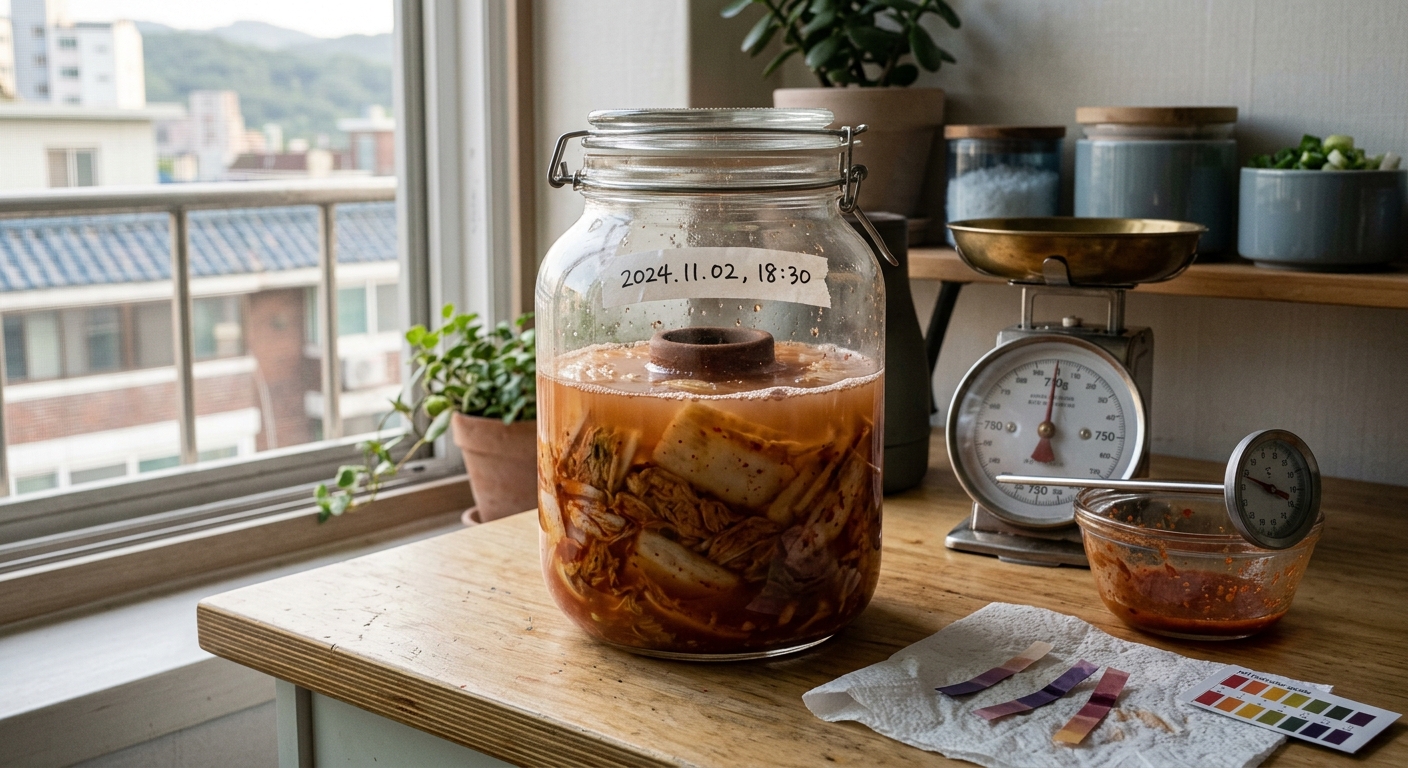
This does not mean that every bubble, surface film, or change in appearance automatically indicates failure. Fermentation is biologically active, and gas production can be normal. The more useful distinction is between expected activity and unexplained deterioration.
For a vegetable ferment, if pieces repeatedly float above the liquid, correct the physical arrangement rather than simply waiting longer. If the vessel is accumulating gas, use a container and closure method appropriate to active fermentation rather than treating pressure as evidence that the ferment is “strong.” If repeated opening is unnecessary, reduce it.
Acidity tells an important story, but not the whole story
Fermentation works partly because microorganisms convert available sugars into organic acids. As acidity rises, pH falls. Government and university food-preservation guidance commonly treats a pH of 4.6 or below as a significant boundary in preservation contexts because Clostridium botulinum cannot grow below that pH.
That statement needs careful interpretation. It does not mean that every homemade fermented food is automatically safe once a pH meter displays a number below 4.6. FDA materials distinguish naturally fermented foods from acidified foods, and food safety depends on the entire process, including formulation, storage, handling, and the characteristics of the particular food.
For this reason, “it smells sour” is weaker evidence than an actual acidity measurement when acidity is the variable you need to know. Conversely, “the pH is low” should not be used to ignore obvious spoilage or an uncontrolled process.
If the decision depends on whether acidification has occurred, measure acidity. If the decision depends on whether the food was made and stored under an appropriate validated process, pH alone is insufficient.
Why over-fermentation can be a quality failure
Fermentation is not automatically better simply because it continues for longer. Reviews of Korean fermented foods describe over-fermented kimchi as becoming excessively acidic, softer in texture, and different in color and sensory character. These changes are not necessarily evidence that fermentation “went wrong” in a microbiological sense; they can instead mean the product moved beyond the sensory stage the cook wanted.
This distinction matters because home cooks sometimes treat sourness as a binary measure: fresh means under-fermented, sour means fermented. In reality, fermentation is a trajectory. A kimchi intended for fresh table eating may have a different ideal stage from kimchi intended for cooking into stew, pancakes, or fried rice.
The practical decision rule is therefore simple: if the intended use is fresh, control fermentation sooner; if the intended use is a cooked dish that benefits from pronounced acidity, a later stage may be desirable. Neither preference changes the need to recognize genuine spoilage or an uncontrolled process.
The less visible issue: fermented seafood ingredients
Korean fermentation is not limited to vegetables. Ingredients such as jeotgal and aekjeot introduce another scientific dimension because fermented seafood can contribute both microorganisms and preformed chemical compounds to a recipe.
Recent peer-reviewed work has highlighted biogenic amines as a relevant consideration in kimchi fermentation. Histamine and tyramine can arise from microbial metabolism, and fermented seafood ingredients can contribute to the overall burden. This is not a reason to portray traditional fermented seafood as inherently dangerous; it is a reason to recognize that ingredient history matters.
If X is a vegetable-only ferment with a well-established process, the major variables may center on salt, temperature, oxygen exposure, and acidification. If not—particularly when fermented seafood ingredients are substantial—the risk picture becomes more complicated, and simply copying the handling of a vegetable ferment may not be appropriate.
Traditional does not mean uncontrolled
There is a false choice between traditional fermentation and scientific process control. Korean fermentation traditions developed through repeated observation, seasonal adaptation, preservation needs, ingredient knowledge, and accumulated practice. Modern microbiology gives us a vocabulary for understanding why some of those practices work.
At the same time, science should not be used to invent a universal “authentic” temperature or salt percentage where the literature shows variation. Kimchi varieties, regional methods, ingredients, and intended storage conditions differ. A number reported in one experiment should not automatically become a rule for every household recipe.
The most useful approach is to identify which variable the evidence actually supports. If a study shows that temperature changes microbial succession, monitor temperature. If research shows that salinity changes fermentation behavior, control salt concentration. If acidity is the critical question, measure pH. If the issue is texture, do not pretend a pH reading can predict crispness by itself.
What to do when a batch behaves differently
A strange result is an opportunity to diagnose the process rather than immediately blaming the recipe. Start by reconstructing the variables that changed. Was the cabbage unusually wet? Was the salt measured by volume instead of weight? Was the kitchen warmer? Was the jar opened frequently? Was a different fermented seafood condiment used? Was the batch refrigerated at a different point?
If only the flavor is different but the process remained controlled, consider normal variation. Raw materials and microbial starting populations naturally vary.
If fermentation is unusually slow, first examine temperature, salt concentration, and ingredient differences. A cold environment or excessive salt can change fermentation kinetics.
If fermentation is unusually fast, examine temperature and sugar availability. A warmer environment can accelerate microbial activity and shift the succession of organisms.
If the food remains above the expected acidity after the intended fermentation period, do not simply extend the process indefinitely. Recheck the method, conditions, and measurement. A failed or stalled fermentation is a process deviation, not a command to wait forever.
A practical action checklist for the next batch
- Measure rather than guess: Weigh salt when the recipe's salt concentration matters, especially when trying to reproduce a previous batch.
- Record temperature: Note the approximate fermentation temperature instead of assuming every kitchen behaves the same.
- Control exposure: Keep vegetable material appropriately below the brine and minimize unnecessary opening.
- Track the trajectory: Record when fermentation begins, when acidity changes become noticeable, and when the food moves to colder storage.
- Use pH information correctly: If acidity is a critical control question, measure it rather than relying solely on taste or bubbling.
- Separate quality from safety: Sourness, softness, or strong aroma may describe ripening, but they are not standalone safety tests.
- Investigate deviations: When a batch behaves unexpectedly, compare salt, temperature, ingredients, vessel handling, and timing before changing several variables at once.
- Know the limits: A home fermentation method for vegetables should not automatically be transferred to meat, seafood, or shelf-stable products requiring a validated process.
Who should use this approach—and who should not
This evidence-led approach is especially useful for home cooks who make kimchi repeatedly and want to understand why batches vary. It is also useful for anyone adapting a family method to a different kitchen climate, ingredient quantity, or storage pattern.
It is less appropriate to improvise when the goal is shelf-stable preservation, commercial production, fermented meat, or another food whose safety depends on tightly validated hurdles. In those cases, household intuition should not replace a tested process and appropriate technical guidance.
There is also a trade-off. More measurement can improve repeatability, but it can turn a traditional cooking activity into a laboratory-style routine. Not every family batch needs extensive instrumentation. The decision should follow the question: if you need repeatability or are investigating an unexpected result, measure the variable responsible for that uncertainty; if you are simply enjoying a familiar, validated household method, avoid adding measurements that do not answer a useful question.
Frequently asked questions
1. Is sour kimchi always safe kimchi?
No. Sourness indicates acid production may have occurred, but taste and aroma are not complete safety tests. Fermentation safety depends on the food, formulation, handling, storage, and process conditions. A low pH can be an important control, but it does not transform every uncontrolled batch into a validated safe product.
2. Why did my kimchi ferment faster than usual?
Temperature is a major possibility. Warmer conditions can alter bacterial succession and accelerate metabolic activity. Differences in salt concentration, raw ingredients, available sugars, and the initial microbial community can also change the rate.
3. Can I simply use less salt to make kimchi healthier?
Not without recognizing that salt is part of the fermentation environment. A changed salt concentration can alter microbial communities, chemistry, texture, and fermentation speed. If reducing salt, treat the modification as a changed process rather than assuming the original schedule remains valid.
4. Should kimchi be kept at room temperature while fermenting?
There is no single room-temperature rule for every kimchi process. Fermentation temperature influences microbial succession and flavor development. A controlled warm stage and subsequent cold storage can produce a different result from prolonged warm storage. Follow a research-based recipe appropriate to the specific food rather than using room temperature as an absolute rule.
5. Do bubbles mean my ferment is healthy?
Bubbles can be a normal consequence of microbial activity and gas production, but they do not identify every microorganism present. Use bubbling as one observation among several rather than as a standalone safety test.
6. Does a pH below 4.6 make homemade fermentation safe?
A pH of 4.6 or below is an important boundary in food-preservation science because it prevents growth of C. botulinum. However, pH is only one part of a complete process assessment. It should not be used to ignore obvious spoilage, poor handling, unsuitable ingredients, or a fermentation method outside its intended scope.
7. Why can two batches made from the same recipe taste different?
Because fermentation is a living, variable process. Raw materials, temperature, salt concentration, ingredient ratios, microbial starting populations, oxygen exposure, and storage timing can all shift the microbial succession and metabolites. Recipe instructions reduce variation; they do not eliminate biology.
8. Is over-fermented kimchi ruined?
Not necessarily. Over-fermentation can produce stronger acidity, softer texture, and altered color. Those changes may make the kimchi less desirable for fresh eating while making it suitable for cooked applications. However, quality changes should not be confused with signs of spoilage or an uncontrolled process.
Conclusion: the real mistake is losing track of the variables
The hidden mistake in homemade Korean fermentation is not necessarily using the “wrong” traditional technique. It is assuming that fermentation will produce the same result while the biological conditions quietly change.
Salt selects. Temperature shifts microbial succession. Sugars provide substrate. Acids accumulate. Oxygen exposure changes the environment. Time allows all of those effects to interact. A jar of kimchi is therefore not simply sitting until a recipe's timer expires; it is moving through a changing microbial ecosystem.
The most reliable home practice is consequently not to make fermentation needlessly complicated, but to make the important variables visible. Keep salt measurement consistent when repeatability matters. Know the fermentation temperature. Keep vegetable ferments appropriately submerged. Measure acidity when acidity is the actual question. Treat fermented seafood ingredients as a separate consideration rather than assuming every ferment has the same risk profile.
That perspective also preserves what is valuable about Korean fermentation traditions. Science does not replace the tradition; it explains why disciplined observation, seasonal adjustment, and careful handling can produce remarkably consistent food from living processes. The better question is no longer “How many days should this ferment?” It is “What conditions is this ferment experiencing, and are those conditions consistent with the food I intend to make?”


Comments
Post a Comment